
Fence and Deck Staining FAQs: Answers to Common Questions
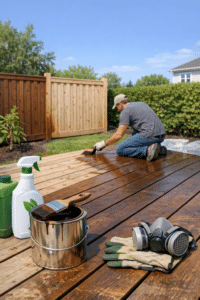
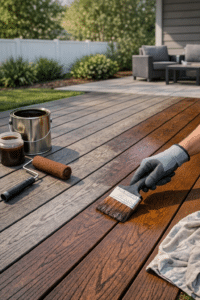
Keeping your wood looking great shouldn’t feel complicated. This fence and deck staining guide gathers clear, practical answers to the most frequently asked questions so you can choose the right product, prep properly, avoid mistakes, and maintain a long-lasting finish. Whether you’re tackling your first DIY project or brushing up for seasonal maintenance, you’ll find straightforward tips and troubleshooting advice to protect your investment and enhance curb appeal.
Stain Basics
What’s the difference between a stain, a sealer, and paint?
Stain adds color and UV protection while penetrating into the wood. A sealer focuses on water repellency and may be clear or lightly tinted. Paint forms a film that completely covers the grain. For fences and decks, stains (often with built-in sealers) are preferred because they protect without creating a thick film that’s more prone to peeling.
Which transparency should I choose: transparent, semi-transparent, or solid?
Transparent highlights natural grain with minimal pigment; great for newer, attractive lumber but offers shorter UV life. Semi-transparent balances grain visibility and protection—ideal for most decks and fences. Solid stains behave like thin paint, hiding grain while delivering the strongest UV shielding; they can peel if prep or application is poor. Choose based on wood condition, desired look, and maintenance preferences.
Oil-based vs. water-based stain—what’s better?
Oil-based stains penetrate deeply, allow more working time, and are often easier to maintain with light recoats. Water-based (and waterborne hybrids) dry faster, have lower odor/VOC options, and resist color fade well. Both can perform excellently when applied correctly. Consider climate, project timeline, VOC rules, and personal preference for cleanup (oil requires mineral spirits; water-based cleans with soap and water).
Preparation and Application
How long should I wait to stain new wood, especially pressure-treated boards?
Let new lumber acclimate and dry until it reliably absorbs water. A simple test: sprinkle water; if it beads, wait. Most pressure-treated wood needs 2–6 months depending on climate. Kiln-dried after treatment (KDAT) lumber can be stained sooner once surface-dry. Aim for wood moisture under roughly 15–18% for best results.
What’s the right way to prep before staining?
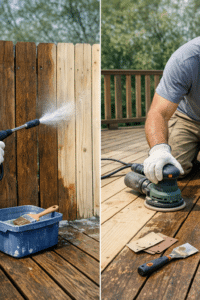
Clean first to remove dirt, gray oxidation, and contaminants. Use an oxygenated cleaner (sodium percarbonate), then follow with a brightener (oxalic acid) to neutralize and open pores. Rinse thoroughly. If pressure washing, keep pressure moderate (about 500–1,200 PSI) with a wide fan tip and steady movement to avoid furring. Let wood dry fully.
Do I need to sand, and which grit works best?
Sanding isn’t always mandatory, but it helps when boards are fuzzy or mill-glazed. Use 60–80 grit on deck surfaces to improve absorption and reduce splinters; use 80–100 grit