
The Impact of Temperature and Humidity on Fence and Deck Staining
Great stain work isn’t just about the brand on the can—it’s about the weather over your head and the moisture in the wood. Temperature and humidity shape how stains penetrate, level, dry, and cure, ultimately determining whether your fence or deck looks smooth and rich or turns sticky, blotchy, or prematurely faded. If you’ve ever wondered why the same product delivered different results on different days, the answer lies in the environment. Below, you’ll find science-backed guidance, practical temperature staining tips, and smart deck care strategies to help you choose the right day, apply the right way, and get a durable, beautiful finish that lasts.
Why Temperature and Humidity Matter
Stains are complex blends of solvents, resins, pigments, and additives. Their performance is highly sensitive to ambient conditions and wood moisture. When humidity is high or temperatures swing outside a product’s recommended range, solvents evaporate too slowly or too quickly, pigments fail to lay down evenly, and resins can’t form a uniform film. In short: the microclimate dictates the macro results.
How Humidity Influences Stain Performance
Humidity effects stain penetration and drying
High relative humidity (RH) slows solvent evaporation and keeps wood fibers swollen with moisture. This can prevent stain from penetrating properly and delay drying, which increases the risk of tackiness, print marks, dust pickup, and mildew. Conversely, very low RH accelerates evaporation, sometimes causing lap marks and uneven color as edges dry faster than adjacent areas. Understanding how humidity effects stain behavior helps you plan the application window and avoid common defects.
Ideal humidity range
For most oil-based and water-based exterior stains, an RH between 40% and 60% is ideal. Many pros will work up to about 70% if the temperature and wind allow for steady evaporation. Above 80%, you’re more likely to see extended dry times, sheen irregularities, and adhesion problems—especially if evening dew arrives before the film sets.
Dew point and condensation risks
If the surface temperature of your fence or deck is at or near the dew point, moisture will condense on the wood and sabotage adhesion. Avoid staining when the air temperature is within 5°F (3°C) of the dew point, or if dew is likely within a few hours of application. Early mornings and late evenings are the most vulnerable times.
Temperature Fundamentals: Practical Temperature Staining Tips
Manufacturer-recommended ranges
Most exterior stains specify an application window—often between 50°F and 90°F (10°C to 32°C). The sweet spot is typically 60°F to 80°F (16°C to 27°C). Follow the label, then use these temperature staining tips to fine-tune your timing.
Hot weather pitfalls
When it’s hot—especially in direct sun on a dark deck—surface temperatures can exceed air temperature by 15–25°F (8–14°C). Rapid solvent flash-off causes poor leveling, lap marks, and light spots. Work in shade, start on the west side in the morning (and east side in the afternoon), and maintain a wet edge to prevent overlap lines.
Cold weather challenges
In cool conditions, stains thicken and penetrate less readily, and water-based products can take far longer to dry. If temperatures drop below the minimum during curing, the film may remain soft or hazy. Plan for a full 24–48 hours above the minimum temperature, including overnight lows.
Wood Moisture Content: The Hidden Variable
Even with perfect weather, high wood moisture can ruin adhesion. Wood should typically be at or below 15% moisture content (MC), with many manufacturers recommending 12% or less. A simple pin-type moisture meter is invaluable. Pressure-washed surfaces often take 48–72 hours (or longer in humid climates) to reach target MC.
Check for trapped moisture
Pay special attention to horizontal deck boards, end grain, and spots shaded by planters or railings. If these areas feel cool to the touch or look darker, they may still be damp inside. Wait until they match the broader surface visually and by meter reading.
Choosing the Right Stain for Your Conditions
Oil-based vs. water-based
Oil-based stains generally penetrate deeply and are more forgiving in slightly higher humidity. Water-based stains dry faster, are lower-odor, and resist mildew growth on the film, but they are more sensitive to high RH and cool temperatures. In humid regions, a high-quality oil-based semi-transparent can be more predictable, while in hot, dry climates, a premium water-based formula may help prevent lap marks.
Opacity and climate
Clear and semi-transparent stains allow more vapor transmission and are often less prone to peeling in variable climates. Solid stains provide strong color and UV protection but require careful prep and stricter environmental controls to avoid film failure. Match opacity to your climate and maintenance expectations for better long-term deck care.
Plan Your Project: Timing and Weather Windows
- Check the forecast for at least a 48-hour rain-free window for oil-based stains and 24–36 hours for water-based (always verify product-specific guidance).
- Aim for mid-morning to early afternoon staining when surfaces are dry, temps are stable, and dew has burned off.
- Work in sections that stay shaded. Use a shade sail if needed to moderate surface temperature.
- Watch the wind: light airflow helps evaporation; strong, dusty winds contaminate the finish.
Surface Prep That Supports Climate-Smart Staining
Clean, brighten, dry
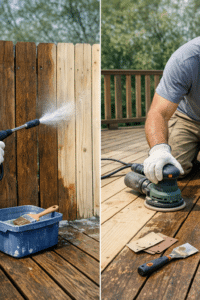
Remove mildew, dirt, and old failing stain with an appropriate cleaner or stripper. Rinse thoroughly. Use a wood brightener to neutralize strippers and balance pH for uniform color. Then allow adequate dry time, confirmed by moisture meter readings.
Sand selectively
Feather edges of worn film and open dense mill glaze on new boards with 80–120 grit. Sanding increases absorption and reduces blotchiness, especially when humidity effects stain penetration. Blow off dust before applying.
Application Techniques That Respect the Weather
Thin, even coats
Apply thin coats to promote even drying. Over-application is the most common cause of tacky or glossy patches in humid or cool conditions.
Back-brush for uniformity
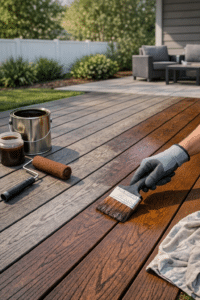
Spray or roll to deliver product, then immediately back-brush with a high-quality natural bristle (for oil) or synthetic (for water-based) brush. This levels the film and reduces lap marks that are amplified by heat or low humidity.
Maintain a wet edge
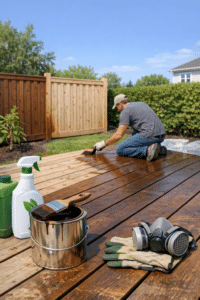
Work board-by-board on decks and picket-by-picket on fences. In hot conditions, reduce section width so you can keep edges wet. This is one of the simplest yet most effective temperature staining tips you can use.
Test first
Do a test patch in the same lighting and sun exposure as the main area. Assess color, absorption, and drying. If the test remains tacky after the label’s dry time, humidity or wood moisture may be too high.
Troubleshooting Climate-Related Problems
Sticky or slow-drying stain
Cause: High RH, low temperature, over-application, or damp wood. Fix: Increase airflow, allow more time, and if still tacky after 24–48 hours (oil) or 12–24 hours (water-based), lightly wipe with mineral spirits (oil-based only) or recoat thinly after scuffing once fully dry. Avoid heavy solvent use on water-based products.
Lap marks and flashing
Cause: Hot surfaces, low RH, or stopping mid-board. Fix: Work in shade, shorten sections, keep a wet edge, and back-brush. On cured laps, lightly abrade and apply a thin blending coat in suitable conditions.
Blistering or peeling
Cause: Moisture trapped under film or staining over dew/damp wood. Fix: Strip or sand failed areas, allow proper dry time, confirm MC, then reapply under correct RH/temperature.
Blotchy color or dark patches
Cause: Uneven absorption due to varied MC or dense grain; humidity effects stain penetration; or overworking. Fix: Use a wood conditioner/brightener, sand dense areas lightly, apply thinner coats, and back-brush consistently.
Mildew and tannin bleed
Cause: Prolonged dry time in humid conditions, organic residue, extractives. Fix: Clean with a mildew wash, brighten, and ensure faster dry by choosing a better weather window.
Regional and Seasonal Considerations
Coastal and humid climates
Frequent high RH demands patience and planning. Choose breathable stains and prioritize late morning starts. Keep an eye on evening dew. Understanding how humidity effects stain curing helps prevent soft films.
Hot, arid zones
Low humidity and intense sun make rapid evaporation the main challenge. Work in shade, use extenders where allowed by the manufacturer, and employ aggressive back-brushing to avoid lap marks. These regions benefit most from tailored temperature staining tips.
Cold or shoulder seasons
Short days and cool nights extend dry times. Favor water-based products designed for low-temp application or wait for a warming trend. Always ensure overnight lows stay above the product minimum.
Long-Term Deck Care and Maintenance
Weather-smart application is step one; ongoing deck care preserves your investment. Clean high-traffic areas each season, remove standing water, and trim vegetation to improve airflow. Expect semi-transparent finishes to need refreshing every 12–36 months depending on sun exposure, traffic, and climate. Solid stains may last longer but require more thorough prep at renewal.
Pro tip: Inspect after extreme seasons
After a humid summer or a freeze–thaw winter, check for early wear on south- and west-facing boards, rail tops, and stair treads. Touch up thin spots before they turn into full refinish projects.
Essential Tools for Weather-Aware Staining
- Moisture meter: Confirms wood is at or below recommended MC.
- Hygrometer/thermometer: Tracks RH and ambient temperature.
- Infrared thermometer: Measures surface temperature on sunny decks.
- Shade solution: Canopy, umbrella, or shade sail to moderate heat.
- High-quality brushes: Natural for oil, synthetic for water-based.
Quick Reference: Best Practices
- Target 60–80°F and 40–60% RH whenever possible.
- Avoid staining within 5°F of the dew point or when dew is imminent.
- Confirm wood MC ≤ 12–15% before starting.
- Apply thin coats and back-brush to level.
- Work in shade and maintain a wet edge.
- Allow full dry/cure time before exposing to rain or heavy traffic.
FAQs
Can I stain if rain is forecast?
Only if the product’s minimum rain-safe window will be met and conditions support proper drying. When humidity is high, extend those windows beyond the label’s minimum to be safe.
Is morning or afternoon better?
Late morning to early afternoon is often best: dew has evaporated, and surfaces are warm but not overheated. Shift your work area to stay in shade as the sun moves.
How often should I recoat?
Depends on exposure, traffic, and product type. Semi-transparent stains may need refreshing every 1–3 years; solid stains can last longer but require more prep at renewal. Regular deck care like cleaning and quick touch-ups extends life.
Conclusion: Master the Weather, Master the Finish
When you understand how humidity effects stain drying and how temperature drives penetration and leveling, you can choose the perfect window, apply with confidence, and enjoy a finish that stands up to the elements. Use the temperature staining tips above, pair them with diligent deck care, and your fence and deck will look better and last longer.
Ready to get pro-level results? Check your forecast, gather your tools, and schedule your staining day now—or reach out to a local finishing professional for a weather-smart plan tailored to your project.